Daniel Arie Chronicles a Remarkable Life of Reinvention, Electronic Cinema and Enduring Love in 9 Lives Like a Cat
New memoir takes readers from Communist Romania to the front lines of Canada’s film and television technology revolution while tracing a love story that spans more than seven decades.
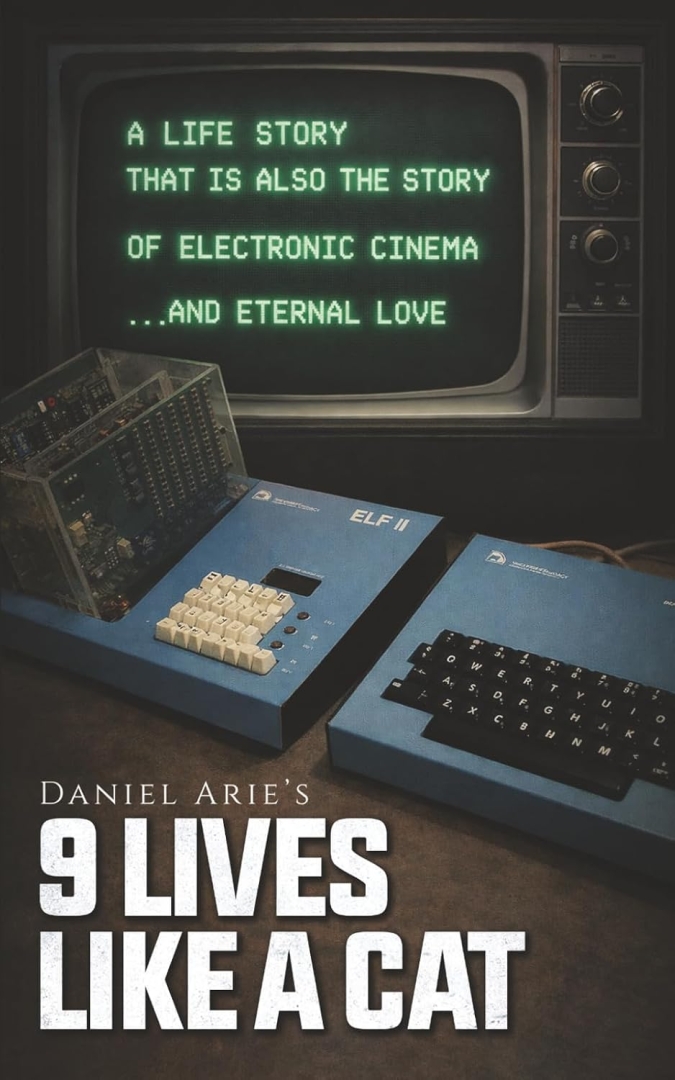
Author, film editor and television systems designer Daniel Arie shares an extraordinary story of survival, innovation, migration and enduring human connection in his newly published memoir, 9 Lives Like a Cat: A Life Story That Is Also the Story of Electronic Cinema … and Eternal Love.
Blending intimate autobiography with an eyewitness account of the technological transformation of cinema, Arie recounts a life repeatedly reshaped by political upheaval, personal loss, professional risk, unexpected opportunity and love. The book’s “nine lives” framework reflects the many identities and new beginnings he experienced while moving from Romania to France, Argentina, Canada and eventually Germany.
Arie’s story begins in Bucharest, where his parents secretly fled Communist Romania when he was a young child, leaving him and his brother in the care of their grandparents. Growing up under an authoritarian regime, he discovered an early fascination with cinema, sound, electronics, literature and the possibility of finding a better way to accomplish difficult tasks.
That belief would eventually become the guiding principle of his career.
After studying at Romania’s Technical School for Cinematography and working in the sound department at the Buftea film studios, Arie left Romania in 1966. His journey carried him through Paris and across the Atlantic to Argentina before he immigrated to Canada in 1968, determined to return to his true calling in cinema.
Over the following five decades, Arie worked as a film editor, post-production specialist, engineer, programmer and television systems designer. He became one of the early adopters of electronic film editing and digital audio techniques. He also designed and helped build multiple production facilities, including Télévision Quatre Saisons, described in the memoir as Canada’s first television installation to use component video technology.
Through companies and facilities such as Onyx Films, Productions Verseau, Telepoint, Motion Picture Video and Centre de Montage Électronique, Arie found himself at the center of an industry transitioning from physical film and magnetic sound to videotape, computer-generated editing lists, digital audio, component video and nonlinear editing.
Using an ELF II home computer and programs he wrote in BASIC, Arie developed methods for accurately connecting video time code with film measurements. His systems helped editors move between film and video while maintaining the precision required for negative cutting and final assembly. Telepoint later used these methods on productions such as the successful Canadian television series Lance et compte.
The memoir also captures the resistance encountered by early electronic editing pioneers. Traditional editors feared that technology would remove the tactile artistry of handling film. Arie, however, recognized that these emerging tools could reduce production costs, improve accuracy, preserve image and sound quality and make sophisticated editing methods more widely accessible. He presents this period as an era of experimentation, trial and error and relentless invention that laid the foundation for modern filmmaking.
Yet 9 Lives Like a Cat is more than a history of cinema technology.
At the emotional center of the memoir is Arie’s connection with Cornelia, affectionately called Nelly. Their relationship begins during childhood in Bucharest, where they grow up in the same divided family residence, become confidants and learn to dance together. Life repeatedly separates them through immigration, marriage, family obligations, geography and professional commitments, but their bond continues across decades.
After years of missed opportunities and separate lives, the two eventually reunite in old age. Arie leaves Canada and begins another life with Nelly in Germany, bringing the memoir’s lifelong romantic journey to a deeply personal conclusion.
Written for readers of memoir, film history, technology, immigration narratives and unconventional love stories, 9 Lives Like a Cat preserves the memories of a generation that witnessed cinema evolve from celluloid reels and mechanical editing tables to computer-assisted post-production and digital workflows.
“I have written this story as a challenge to myself and as a testimony to a life made up of many different lives,” Arie explains in the memoir. His story also serves as a tribute to an age of invention when, in his words, everything seemed possible under the belief that “there must be a better way.”
9 Lives Like a Cat: A Life Story That Is Also the Story of Electronic Cinema … and Eternal Love is now available on Amazon.
About the Author
Daniel Arie worked in Canada for approximately 50 years as a film editor and television systems designer. Among the early professionals to use electronic editing and digital audio techniques, he contributed to the development of post-production workflows and designed film and television facilities, including Télévision Quatre Saisons. His memoir combines his firsthand account of electronic cinema’s development with a personal story of migration, reinvention, friendship, creativity and lifelong love.
Book Name: 9 Lives Like a Cat
Author Name: Daniel Arie
ISBN Number: 979-8951390202
Paperback Version: Click Here
Kindle Version: Click Here
Media Contact
Company Name: Western Publishing House
Email: Send Email
Phone: +1-860-764-8454
Address:175 Capital BLvd 4th Fl
City: Rocky Hill
State: CT 06067
Country: United States
Website: https://westernpublishinghouse.com


